Lincoln Hayes
Humes 103
Dr. Robb
Sept 28, 2023
Pledged
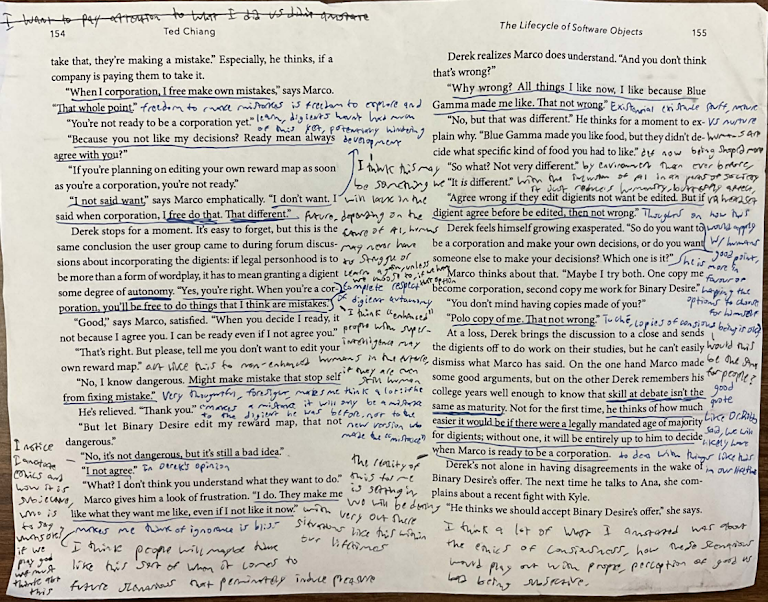
In the passage The lifecycle of software objects we see how the ethics of digients change when applied to humans. In my annotations I paid a lot of attention to the ethics of the digients and how the ethics would change if applied to humans. In his writing, Chiang attempted to spark thought-provoking concepts related to the ethics of conscious beings and a potential future full of sentient software objects that we may have to deal with. I was especially fascinated with the concept of Marco being impartial to having his reward map altered by Binary Desire when he said, “They make me like what they want me like, even if I not like it now” (Chiang 154). Logically, if he was given new desires that aligned with the Binary Desire company that would simply become his new life and identity and he would be equally as satisfied. Marcos’s logic-based conclusion makes perfect sense to him, but most humans would likely not agree with this line of reasoning.
The reactions Derek has in his conversation with Marco make me question my human-centric perspective. Derek doesn’t explain why but he thinks it is simply a “bad idea” (Chiang 154) to alter Marco’s reward map. Because of the restrictions of our current time we are biased as to what we believe is necessary to be human. As we progress towards an uncertain future, things like free will or identity, crucial aspects of humanity as of now, may be seen as alterable. This can be seen in a being like Marco who reasonably accepts that he will be happy depending on the environment he is put in when he is altered to like other things. The way Marco is fine with letting a corporation change his identity through altering his “reward map” (Chiang 154) is a chilling prospect to humans but to other forms of intelligence it may appear obvious as the right decision. In our future where corporations like Binary Desire may present us with options of altering these basic human traits such as our own “reward map” (Chiang 154) to optimize pleasure, we will have to address the associated ethical considerations.
If digients are content with altering their reward maps, future people may feel neutral, even eager, to alter their lives to experience more satisfaction. We may be presented with a future full of people living their lives inside of pleasure cubes that hook up to our brains to constantly release serotonin and dopamine. To society now this seems like a dystopian and hollow existence but is a modern human centric view. Using logic similar to Marcos’s, if you are in the pleasure cube it makes perfect sense to spend the rest of your life there and you would wonder why you ever tolerated living outside of it. However, if you live outside the pleasure cube you might view that those who decide to spend their lives in the pleasure cubes are simply giving up on life. As these options become available, we should debate these contrasting views.
In the future we will encounter similar situations that the characters in The Lifecycle of Software Objects experienced. Adapting to new ways of existing will involve interpreting what is right and wrong and what keeps people human.
Pledged
Work Cited
Chiang, Ted. “The lifecycle of software Objects.” Exhalation, Knopf, 2019, pp. 154-155
Annotations
First round (Blue)
- (First page) Freedom to make mistakes is freedom to explore and learn, digients haven’t had much of this yet, potentially hindering development
- Complete respect of digient autonomy
- Very thoughtful, foresight makes me think a lot if he makes a mistake it will only be a mistake to the digient he was before, not to the new version who made the “mistake”
- In Dereks opinion
- Makes me think of ignorance is bliss
- (Second page) Existential existence stuff, nature vs nurture
- Thoughts on how this would apply w/ humans
- Good point he is more in favor if having the options to himself
- Tu che, copies of conscious being is ok?
- Good quote
- Like Dr. Robb said, we will likely have to deal with things like this in our lifetime
Second round (black)
- (First page) I think this may be something we will lack in the future, depending on the future of AI, humans may never have to struggle or learn again, unless we choose to if we have that option
- I think “enhanced” people with super intelligent may act like this non-enhanced humans in the future, if they are even still human
- I notice I annotate ethics and how it is subjective, who is to say what’s ok? If we play god we must think about this
- I think people will maybe think like this sort of when it comes to future scenarios that predominately induce pleasure
- (Second page) humans are definitely now being shaped more by environment than ever before, with the inclusion of AI and in parts of society it just reduces humanity, butterfly affect, VR headset
- Would this be the same for people?
- The reality of this for me is setting in, we will be dealing with very out there situations like this within our lifetimes
- I think a lot of what I annotated was about the ethics of consciousness, how these scenarios would play out with people, perception of good vs bad being subjective